The rapid expansion of artificial intelligence, cloud computing and high-density computing is transforming more than the technology industry. It is also changing the way engineers, mechanical contractors and facility owners approach the infrastructure supporting today’s data centers.
The International Energy Agency projects that worldwide data-center electricity consumption could roughly double from approximately 485 TWh in 2025 to around 950 TWh by 2030. In the United States, data centers are expected to represent a significant share of electricity-demand growth through the end of the decade.
For the mechanical industry, this expansion creates another challenge: how do we reliably manage the enormous amount of heat, mechanical energy, vibration and noise associated with increasingly dense computing environments?
The answer is placing greater importance on well-designed hydronic, vibration/seismic and noise control systems.
At Mason-Dallas, these are the types of applications we have focused on for decades.
The Move Toward Higher-Density Data Centers
Traditional data centers have relied heavily on air cooling to remove heat generated by servers and networking equipment.
That equation is changing.
As processors become increasingly powerful and equipment racks become denser, the industry is moving toward greater use of liquid cooling. ASHRAE has identified the increasing adoption of liquid-cooled computers as an important consideration for both new data-center design and existing-facility retrofits.
The subject has become significant enough that data-center cooling was among the major topics featured at the 2026 ASHRAE Annual Conference, including sessions addressing direct-to-chip liquid cooling, fluid quality monitoring and HVAC design for data centers.
For mechanical professionals, that means the hydronic infrastructure behind these facilities deserves even greater attention.
1. Hydronic Systems Are Becoming Increasingly Critical
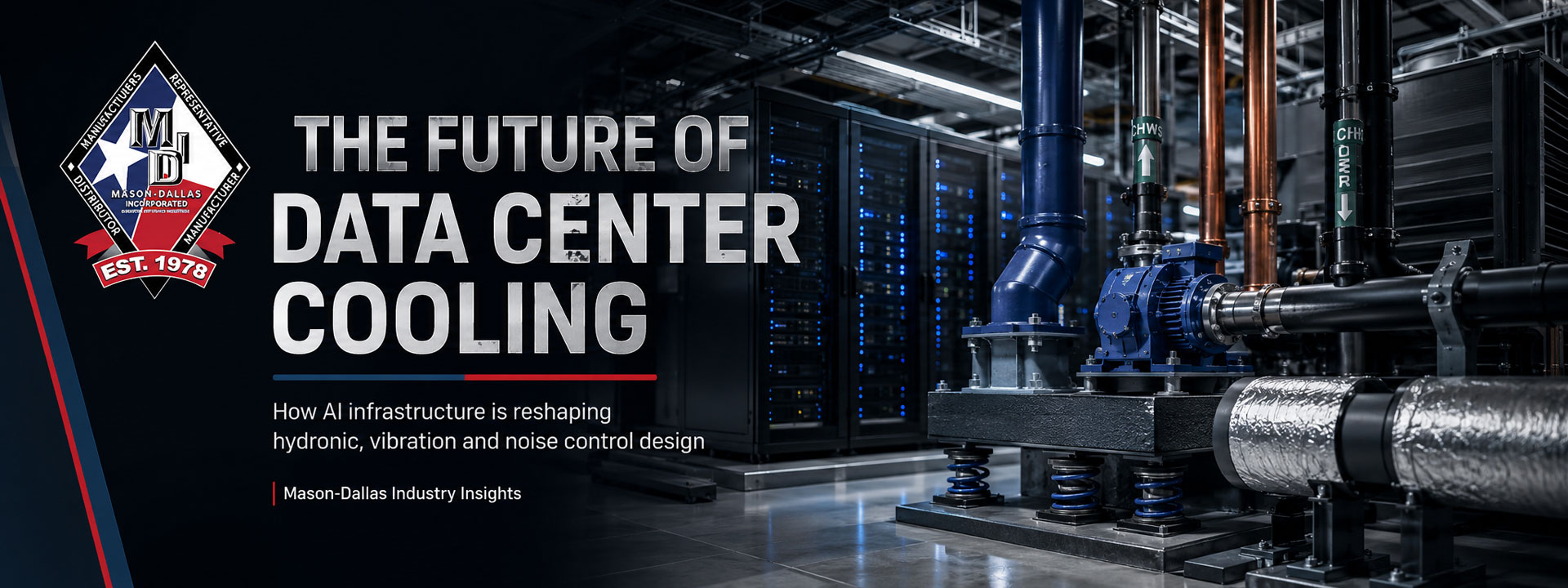
Liquid cooling places water-based and other fluid-based cooling systems closer to the computing equipment itself.
That creates a much larger ecosystem involving components such as:
- Pumps
- Piping systems
- Heat exchangers
- Cooling distribution equipment
- Valves
- Expansion and pressure-control components
- Flexible connections
- Supports and restraints
The objective is not simply to move fluid from one location to another. The system must operate reliably while supporting highly sensitive and expensive technology infrastructure.
ASHRAE’s recent work on liquid cooling emphasizes that understanding liquid-cooling components and system design is becoming increasingly important to developing resilient and energy-efficient data-center cooling systems.
As these systems grow in complexity, proper equipment selection, system coordination and application engineering become increasingly important.
2. Vibration Isolation Cannot Be an Afterthought
A data center may look relatively quiet from the outside, but behind the scenes there can be considerable mechanical activity.
Pumps, chillers, cooling towers, air-handling equipment, generators and other mechanical systems can produce vibration that travels through piping, structural components and the building itself.
Without appropriate isolation, vibration can potentially:
- Transfer through piping systems
- Create unwanted structural noise
- Increase equipment movement
- Affect neighboring spaces
- Contribute to long-term wear
- Create occupant or operational concerns
As mechanical systems become more sophisticated, vibration control should be considered as part of the overall mechanical design rather than treated as an accessory added near the end of construction.
Properly selected vibration isolators, flexible connections, inertia bases, spring isolators and related products can help separate mechanical equipment from the surrounding structure.
For mission-critical environments, small details can have large consequences.
3. Noise Control Matters Even in Mission-Critical Facilities
Noise control is sometimes associated primarily with theaters, hospitals, hotels and other occupant-sensitive environments.
But data centers present their own acoustic challenges.
Cooling equipment, high-volume air movement, mechanical pumps, generators and supporting infrastructure can create significant sound levels.
Noise can travel through:
- Mechanical rooms
- Piping
- Ductwork
- Structural connections
- Equipment supports
- Exterior equipment installations
Addressing these pathways early in the project can help engineers and contractors develop a more complete mechanical solution.
The ultimate goal extends beyond simply making equipment quieter.
It is about controlling how mechanical energy is transferred throughout the facility.
4. Seismic Restraint and Equipment Stability Remain Essential
Today’s mechanical systems often contain large, heavy and interconnected pieces of equipment.
Depending on the project location, building requirements and applicable codes, mechanical equipment and piping may require appropriate seismic restraint.
Data centers can make this especially important because of their mission-critical nature.
Cooling equipment, piping, electrical infrastructure and related systems must work together as a coordinated system.
The growing complexity of AI-oriented data centers is one reason ASHRAE, NEMA and Pacific Northwest National Laboratory released an AI Data Center Energy Performance Framework in 2026. The organizations specifically emphasized the need for coordination between electrical infrastructure, cooling and thermal management to improve safety, reliability and efficiency.
This type of integrated design philosophy will likely become increasingly important as facilities grow larger and more complex.
5. Energy Efficiency Is Raising the Standard for Mechanical Design
Energy consumption is becoming another major consideration.
ASHRAE’s Standard 90.4-2025, Energy Standard for Data Centers, establishes minimum energy-efficiency requirements for the design, construction, operation and maintenance of data centers.
The implication for the mechanical industry is clear:
Efficiency cannot be considered independently from mechanical performance.
Selecting the right pumps, piping arrangements, isolation components and supporting mechanical products contributes to a larger system designed around reliability and efficiency.
And as data-center demand grows, those decisions become increasingly important.
Texas Is Positioned at the Center of the Conversation
The expansion of data centers and other technology infrastructure is particularly relevant for Texas.
Facilities supporting AI, cloud computing, telecommunications and enterprise technology require significant mechanical infrastructure—and their requirements continue to evolve as equipment densities increase.
For engineers and mechanical contractors working on these projects, the challenge is no longer simply selecting individual components.
It is understanding how the entire mechanical system interacts.
Hydronics, vibration, seismic restraint and acoustics all become pieces of the same puzzle.
Experience Matters When Applications Become More Complex
Technology may change quickly, but one principle remains constant:
The right product must be matched to the right application.
That requires product knowledge, engineering awareness and an understanding of how mechanical components will behave within the finished system.
Since 1978, Mason-Dallas has focused on providing solutions for:
Hydronic Applications
Products and solutions supporting effective heating and cooling water systems.
Vibration Isolation
Solutions designed to help reduce the transfer of mechanical vibration from equipment into piping and building structures.
Seismic Applications
Products supporting equipment and mechanical-system restraint requirements.
Noise Control
Solutions designed to reduce unwanted mechanical noise and create quieter, more comfortable environments.
Preparing for the Next Generation of Facilities
The acceleration of AI and data-center development represents much more than a technology trend.
It is creating a new generation of mechanical design challenges.
Higher equipment densities are increasing cooling requirements. Liquid cooling is expanding the role of hydronic systems. More sophisticated mechanical infrastructure creates additional considerations involving vibration, movement, sound and equipment restraint.
And expectations for reliability continue to rise.
For engineers and mechanical contractors, successful projects will increasingly depend on viewing these systems as interconnected rather than independent.
Hydronics. Vibration. Seismic. Noise Control.
Each plays a role in creating mechanical infrastructure designed for long-term performance.
Let’s Talk About Your Next Project
Whether your next application involves a data center, healthcare facility, corporate campus, educational facility, airport, performing arts venue or other commercial project, the Mason-Dallas team is ready to help identify products and solutions for demanding mechanical applications.
Offering Solutions for Hydronic, Vibration/Seismic and Noise Control Applications.
Making your world a quieter and more comfortable place.
Contact Mason-Dallas today to discuss your next project.