The Engineering You Don’t See May Be the Engineering That Matters Most
When people walk into a great building, they usually notice the architecture.
They see the expansive lobby, dramatic glass, comfortable interior, impressive auditorium, stadium seating or state-of-the-art technology.
What they rarely see is everything working behind the scenes to make that experience possible.
Mechanical equipment is operating. Pumps are circulating water. Piping systems are expanding and contracting. Air-handling equipment is moving enormous volumes of air. Chillers, cooling towers and generators are running. Structural systems are carrying loads while sophisticated equipment operates throughout the building.
And when those systems are properly designed, isolated and supported, the occupants may barely notice them.
That is the point.
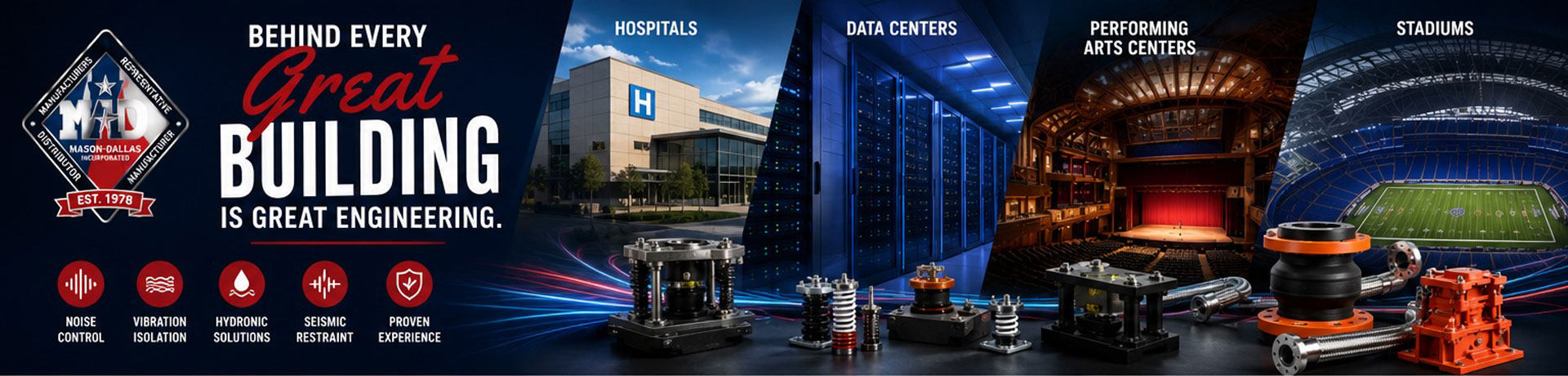
At Mason-Dallas, we believe behind every great building is great engineering.
For decades, we have provided products and application solutions for hydronic, vibration/seismic and noise control applications, helping contractors, engineers and project teams create quieter, more comfortable and better-performing environments.
BUILDINGS ARE BECOMING MORE COMPLEX
Today’s commercial and institutional buildings are expected to accomplish more than ever before.
Hospitals operate sophisticated medical technology around the clock.
Data centers support enormous computing workloads and increasingly dense equipment.
Universities combine classrooms, laboratories, research environments and performing arts facilities.
Stadiums accommodate tens of thousands of occupants while relying on extensive mechanical infrastructure.
Hotels and office developments must create comfortable environments while operating efficiently.
Behind all of these facilities is increasingly sophisticated mechanical infrastructure.
As systems become more complex, coordination between equipment, piping, building structure, acoustics and controls becomes increasingly important.
The engineering industry is recognizing this shift. ASHRAE’s 2026 AI Data Center Energy Performance Framework, for example, emphasizes integrated design, thermal efficiency, commissioning, resiliency and performance validation rather than treating individual building systems in isolation.
That philosophy extends well beyond data centers.
A building performs best when its systems work together.

1. HOSPITALS: WHERE COMFORT AND RELIABILITY MATTER EVERY MINUTE
Few environments demonstrate the importance of mechanical performance better than healthcare facilities.
Hospitals contain pumps, air-handling equipment, chillers, emergency generators, medical equipment and extensive piping networks. Many of these systems operate continuously.
At the same time, the environment needs to remain comfortable for patients, physicians, nurses and visitors.
Mechanical vibration or unwanted noise that might be a minor inconvenience in another building can become much more noticeable in a patient room, treatment area or other sensitive healthcare space.
That makes equipment isolation and noise control important considerations in the overall mechanical system.
Solutions may include:
- Spring vibration isolators
- Elastomeric isolation
- Equipment bases
- Flexible piping connections
- Pipe isolation
- Mechanical equipment supports
- Noise-control products
- Seismic restraints
The objective is not simply to install mechanical equipment.
It is to help that equipment operate as part of a coordinated building system.
2. PERFORMING ARTS CENTERS: WHEN QUIET BECOMES PART OF THE DESIGN
Walk into a concert hall before a performance begins and you immediately understand the importance of acoustics.
These environments are intentionally designed around sound.
That means unwanted sound becomes particularly noticeable.
A pump operating several rooms away, vibration transmitted through piping or mechanical equipment connected directly to a structure can potentially introduce unwanted noise into acoustically sensitive areas.
For performing arts facilities, vibration and noise control become part of the building experience itself.
The goal is straightforward:
The audience should hear the performance—not the building’s mechanical systems.
Mason-Dallas has been involved with prominent performing arts and cultural projects including:
- Winspear Opera House
- Bass Performance Hall
- Meyerson Concert Hall
- UNT Murchison Performing Arts
- Theater Squared Performing Arts
- Robinson Auditorium
- Perot Museum
Projects like these illustrate why vibration isolation and noise-control considerations should be integrated into mechanical design rather than addressed as an afterthought.
Current federal mechanical-design guidance likewise recognizes noise and vibration control as a distinct part of mechanical-system engineering. Updated U.S. Department of Defense guidance issued in 2026 replaced its previous standalone noise-and-vibration standard with updated technical guidance incorporated into its mechanical engineering framework.
3. DATA CENTERS: MORE COMPUTING POWER MEANS MORE MECHANICAL DEMANDS
Few sectors are changing as rapidly as data centers.
Artificial intelligence and high-performance computing are increasing equipment densities and generating significantly greater cooling requirements.
That is accelerating interest in liquid cooling and sophisticated hydronic infrastructure.
ASHRAE notes that liquid-cooled data-center configurations can involve facility chilled water, cooling distribution units, pumps, valves, heat exchangers, controls and dedicated piping systems.
That means the mechanical infrastructure surrounding the servers is becoming increasingly important.
Pumps create vibration.
Piping moves and expands.
Cooling equipment operates continuously.
Large mechanical systems may require isolation and restraint.
The systems that keep technology operating must themselves be engineered for dependable performance.
This is why data-center development is becoming as much a mechanical engineering story as it is a technology story.
4. UNIVERSITIES AND RESEARCH FACILITIES: ONE CAMPUS, MANY ENVIRONMENTS
A modern university can contain almost every type of building environment within a single campus.
Consider the range:
Classrooms.
Laboratories.
Research facilities.
Performing arts centers.
Athletic facilities.
Medical education buildings.
Administrative offices.
Each has different requirements, yet each depends on reliable mechanical infrastructure.
A laboratory may require particularly stable operating conditions.
A music facility may prioritize acoustics.
A classroom building may prioritize comfort.
A research facility may contain sensitive equipment.
The mechanical solutions therefore need to reflect the application rather than relying on a one-size-fits-all approach.
Mason-Dallas has supported projects including:
- TCU School of Music
- TAMU AgriLife Center
- TAMU College of Dentistry
- Dell Research Facility
- UNT Murchison Performing Arts
- UTA Engineering Building
Different buildings.
Different mechanical challenges.
The same underlying principle:
Understand the application before selecting the solution.
5. STADIUMS AND LARGE VENUES: ENGINEERING AT SCALE
A stadium is essentially a small city operating inside one structure.
Thousands of occupants may arrive within a short period of time.
Restaurants and concessions operate simultaneously.
Restrooms experience enormous demand.
Clubs, suites, locker rooms, offices and public areas all require environmental control.
Behind the scenes, extensive mechanical systems are working to support the facility.
Large pumps, piping networks, air-handling systems and other equipment introduce another challenge:
scale.
As equipment size and system capacity increase, vibration isolation, equipment support and proper mechanical coordination become even more important.
Mason-Dallas’ project experience includes major sports and entertainment environments such as:
- The Star in Frisco
- Cowboy Stadium in Arlington
- Tarleton State Memorial Stadium
These projects demonstrate that mechanical performance must scale along with the building.
6. CORPORATE AND COMMERCIAL BUILDINGS: COMFORT BECOMES PART OF THE EXPERIENCE
Employees may never see the mechanical room.
Visitors may never know where the pumps or air handlers are located.
But they experience the results every day.
A successful commercial environment should feel comfortable without calling attention to the systems creating that comfort.
Mechanical vibration should not travel noticeably into occupied areas.
Equipment noise should be controlled.
Hydronic systems should perform as intended.
Piping and equipment should be appropriately supported.
This is where thoughtful mechanical design becomes part of the overall customer and occupant experience.
Mason-Dallas has supported recognizable corporate and commercial projects including:
- Charles Schwab DFW Campus
- One Toyota North America Headquarters
- JP Morgan Chase Headquarters
- AMD Headquarters
- Pier One Headquarters
- Radio Shack Headquarters
These buildings may look dramatically different from one another, but they all depend on sophisticated infrastructure operating behind the scenes.
VIBRATION DOESN’T ALWAYS STAY AT THE EQUIPMENT
One of the most important concepts in vibration control is understanding that vibration can travel.
Mechanical equipment can create energy that moves through:
- Equipment bases
- Structural slabs
- Steel framing
- Piping
- Ductwork
- Hangers
- Mechanical connections
This is why simply looking at the equipment itself may not tell the entire story.
The question becomes:
How will the equipment interact with the rest of the building?
Proper isolation helps interrupt those transmission paths.
Depending on the application, solutions can include spring isolators, elastomeric products, inertia bases, flexible connections and properly designed equipment supports.
The objective is to control mechanical energy before it becomes an unwanted building-wide issue.
HYDRONIC SYSTEMS ARE PART OF THE SAME CONVERSATION
Hydronic systems move heated and chilled water throughout commercial buildings.
But water is only part of the equation.
Pumps create mechanical forces.
Piping expands and contracts.
Equipment starts and stops.
Pressure changes occur.
Components interact with the building structure.
Successful hydronic design therefore requires careful attention to how the entire system functions.
And with industries such as data centers increasingly adopting liquid-based cooling strategies, hydronic expertise is becoming even more relevant. ASHRAE’s technical guidance describes cooling distribution systems incorporating pumps, valves, heat exchangers, controls and dedicated piping as part of modern liquid-cooled computing environments.
SEISMIC RESTRAINT: PROTECTING THE SYSTEM, NOT JUST THE EQUIPMENT
Mechanical equipment does not operate independently of the building around it.
Piping, ductwork and equipment may require appropriate restraint based on the project’s design requirements, location and applicable codes.
Seismic solutions are therefore about more than simply securing one piece of equipment.
They require consideration of the mechanical system as a whole.
Properly selected restraint solutions can help support system integrity and protect mechanical installations when structural movement occurs.
It is another example of engineering that occupants may never notice—but that matters greatly when required.
GREAT ENGINEERING OFTEN GOES UNNOTICED
There is an interesting paradox in mechanical engineering.
Some of the best engineering is the engineering no one notices.
The room is comfortable.
The equipment operates.
The building is quiet.
The piping performs.
The mechanical system does what it was designed to do.
There is no reason for the occupant to think about what is happening behind the wall, above the ceiling or inside the mechanical room.
And that is precisely why those details matter.
WE DON’T JUST SUPPORT BUILDINGS. WE HELP THEM PERFORM.
Since 1978, Mason-Dallas has worked with contractors, engineers and construction professionals on projects throughout Texas and the surrounding region.
Our experience spans:
Hospitals
Data Centers
Performing Arts Centers
Universities
Commercial Developments
Corporate Headquarters
Airports
Stadiums
Hospitality
Specialty Facilities
Although each project is different, our approach remains consistent.
Understand the application.
Identify the challenge.
Provide knowledgeable product support.
Help our customers find the appropriate solution.
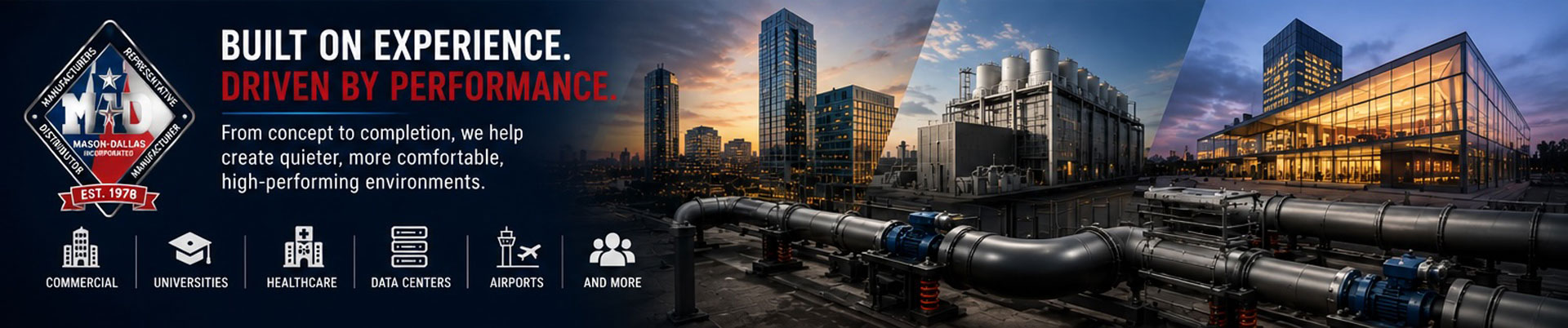
BUILT ON EXPERIENCE. DRIVEN BY PERFORMANCE.
Behind every impressive building are countless decisions most people will never see.
How equipment is supported.
How piping moves.
How vibration is isolated.
How mechanical noise is controlled.
How systems are restrained.
How components work together.
Those decisions ultimately contribute to how the building performs.
At Mason-Dallas, that is where we work best:
Behind the scenes, helping create quieter, more comfortable and better-performing environments.
Offering Solutions for Hydronic, Vibration/Seismic and Noise Control Applications
Making your world a quieter and more comfortable place.
Have a Project in Development?
Whether you’re working on a healthcare facility, data center, university, performing arts venue, stadium, commercial development or another demanding mechanical application, talk with Mason-Dallas about the products and solutions available for your project.